
Purpose
LBS-A Davit-launched Lifeboat Simulator is intended for drilling practical skills of candidates for a certificate of proficiency in survival craft and rescue boats other than fast rescue boats in accordance with requirements of:
- Regulation VI/2 STCW Convention,
- Section A-VI/2, Table A-VI/2-1 STCW Code,
- Section A-VI/1, Table A-VI/1-1 STCW Code,
- IMO Model Course 1.23 Proficiency in survival craft and rescue boats other than fast rescue boats (2024 Edition)
Implementing of simulator into the training process will provide training center conformity with IMO Model Course 1.23 “PROFICIENCY IN SURVIVAL CRAFT AND RESCUE BOATS OTHER THAN FAST RESCUE BOATS” (2024 edition).
New edition emphasizes practical training sessions, that require access to a navigable river, lake or the sea, preferably in harbour or estuarial waters. The practical drills and evaluation could be carried out aboard a ship, making use of its equipment and facilities.
At the same time, the training elements of the practical drills and exercises related to the launch, recovery, operation and manoeuvring of lifeboats and rescue boats, including night drills, drills into rough seas, and drills in ice covered waters may be conducted using simulation.
Training elements related to equipment familiarization and survival craft seamanship should still be delivered using an actual survival craft conforming to the LSA Code.
The simulator can be used to train the coxswains of lifeboats operated on mobile offshore units in accordance with OPITO standard "Offshore Lifeboat Coxswain Training"
Knowledge and skills
The simulator allows to drill the following skills:
- boarding lifeboat,
- launching and recovery lifeboat,
- clear the ship’s side,
- handling and manoeuvring of lifeboats in different weather conditions, including rough seas, and at night,
- steer a lifeboat by compass,
- beaching lifeboat.
Structure
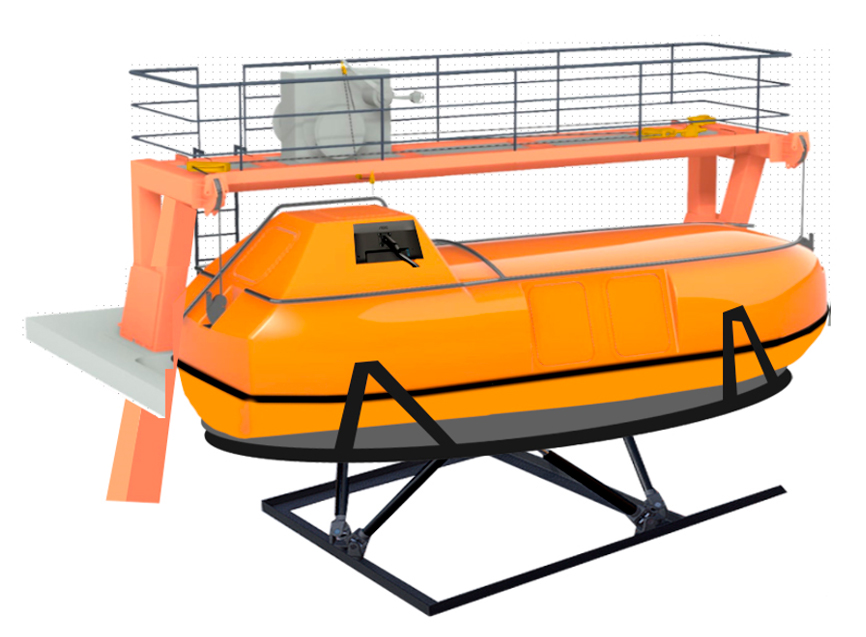
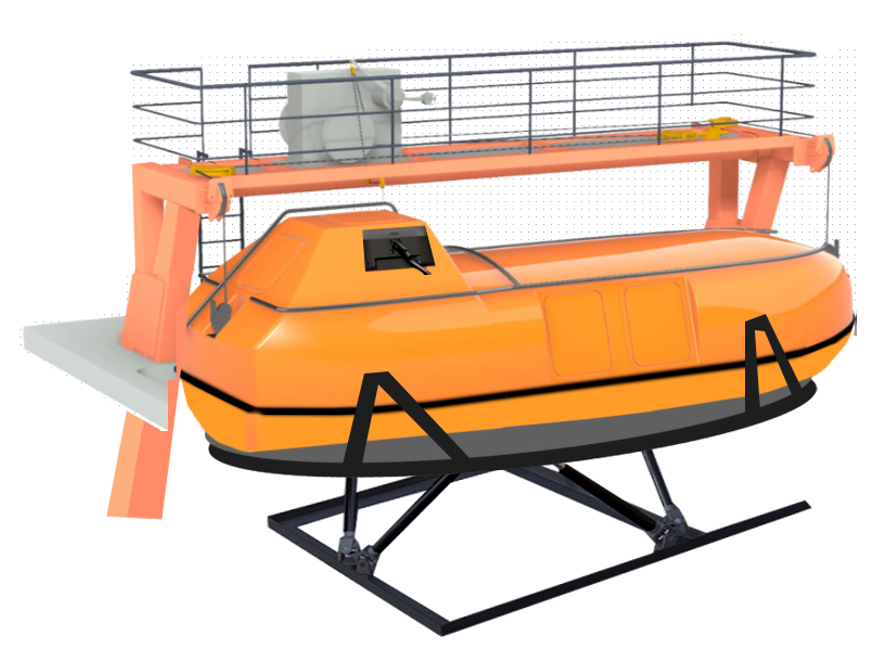
The simulator includes the following equipment and software:\
- gangway and embarkation station,
- lifeboat model, which is a part of a real fire-retardant lifeboat, conforming with LSA Code.
- local control panel of a davit,
- 6 DoF dynamic platform
- computer equipment,
- CCTV equipment,
- simulator software.
Lifeboat model
The used lifeboat model is a part of a real fire-retardant lifeboat, that is comply with LSA Code.
The model is designed to seat a coxswain and 4 crew members.
At the request of the customer, the hull of the lifeboat can be marked with the special name of the ship or name of the organization and port of registry as well as logotype.
The main parts of lifeboat model.
- Doors and clips, portholes,
- Coxswain seat with safety seatbelts,
- Local control panel of launched and recovery device,
- Lever for remote release,
- Hooks of release device,
- Lifeboat control panel: engine control panel, steering wheel, engine control throttle,
- Crewmember seats with seatbelts,
- Remote control panel of a davit,
- Battery switch.
VHF stations are used for the instructor's interaction with the coxswain.
Dynamic platform
The dynamic platform is designed for mounting a model of a lifeboat with a crew of not more than 5 persons on it and ensures the movement of the lifeboat along the trajectories and at the speed set in the software, including launching, recovery and float free, as well as the behavior of the lifeboat on the water surface in rough sea. Before launching, the dynamic platform performs movements that simulate the movement of a vessel on the waves.
CCTV equipment
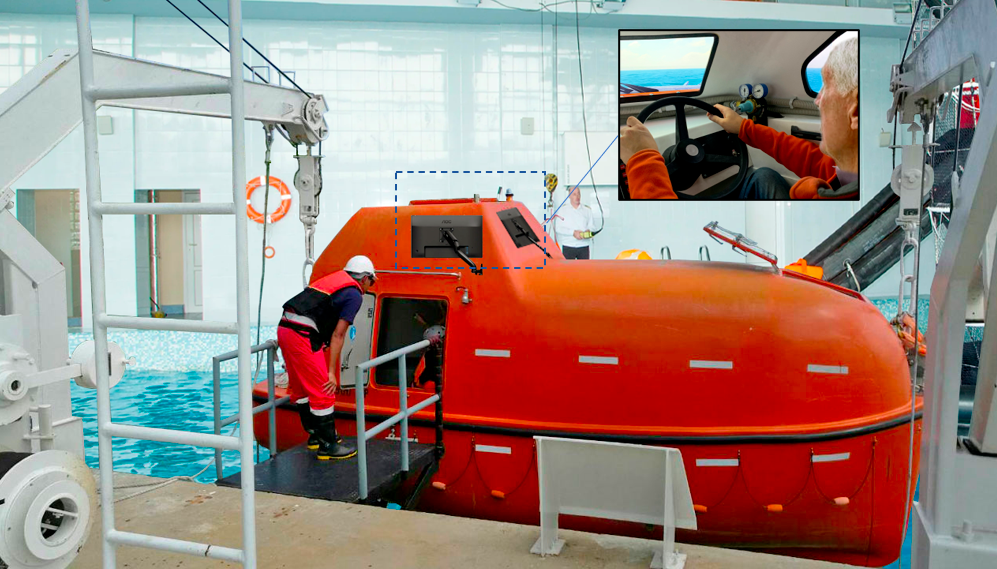
CCTV system is installed in the cockpit of the lifeboat with information display to the instructor's workplace, and with the possibility of recording and archiving performance of exercises.
Simulator software
The software consists of:
- Instructor WorkPlace (IWP),
- Student WorkPlace (SWP),
- Dynamic platform control module,
- Module for processing commands from the lifeboat controls.
IWP functions:
- choice of the navigation area;
- adjusting wave height, time of day, visibility restrictions, lifeboat drift speed and direction;
- video and audio monitoring of what is happening inside and outside the cockpit.
- video recording for debriefing.
- emergency stop of the exercise, return of the simulator to its initial state.
SWP functions:
- Lifeboat operation, including:
- launch and recovery,
- clearing the distress ship’s side and lifeboat handling in rough sea and in different weather conditions,
- use of steering gear,
- steering a lifeboat by compass,
- beaching a lifeboat,
- display of the surface situation.
- Open sea with a vessel in distress and the rescue vessel.
- A part of the sea near coastline, for drilling skills of intentional grounding a lifeboat.
Dynamic platform control module
The module controls the dynamic platform in order to ensure its movement along the trajectories corresponding to the launching and recovery, as well as the behavior of the lifeboat on the water surface in rough weather.
Module for processing commands from the lifeboat controls
The module ensures processing commands from the following controls:
- engine control panel buttons,
- engine throttle,
- main steering gear,
- release devices,
- local and remote-control panel of a launch and recovery device.
Methodical guidelines for using the simulator
The simulator is supplied in the set with the guidelines for the use of the simulator, developed in accordance with the Technical description and operating instructions for the fire-retardant lifeboat.
Operating conditions of the simulator
Requirements for the premises for the delivery, installation, storage and use of the simulator:
- heated, dry, enclosed, well-lit, with dimensions: for the model of the lifeboat, platform and ladder with the embarkation station - at least (L x W x H, m) - 10 x 10 x 5; for the instructor's workplace - at least (L x W, m) - 2 x 2;
- a separate, well-ventilated or forced-cooled premise for a hydraulic oil station with dimensions of at least (L x W, m) - 3 x 3.
- stationary electric network 220V and 380V, total power consumption of at least 10 kW.
Additional options
The simulator can be supplied with e-learning modules for theoretical education, multimedia training software for practice, and knowledge assessment software for testing, which are combined into training package on the proficiency in survival crafts.
Simulator classes
The simulator can be presented in different classes:
- LBS-A1 - full mission, on the dynamic platform, сlass A,
- LBS-A2 - full mission, without the dynamic platform, сlass A,
- LBS-B - with simplified lifeboat model, сlass B,
- LBS-C - computer version with pseudo-real control organs, сlass С (about SRV Survival Craft Simulator).
Legislation
- Regulation VI/2 STCW Convention, Section A-VI/2 STCW Code, Table A-VI/2-1 “Specification of the minimum standard of competence in survival craft and rescue boats other than fast rescue boats” ,
- IMO Model Course 1.23 “Proficiency in Survival Craft and Rescue Boats (other than Fast Rescue Boats)” (2024 Edition),
- Section B-I/14 STCW Code “Guidance regarding the responsibilities of companies and recommended responsibilities of masters and crew members”’.
- Regulation VI/1 STCW Convention, Section A-VI/1 STCW Code, Table A-VI/1-1 “Specification of minimum standard of competence in personal survival techniques",
- OPITO Offshore Lifeboat Coxswain Training Standard.