
Purpose
RB/FRBS-A Rescue/Fast rescue boat is intended for training of seafarers who are designated to take charge of rescue/fast rescue boats in accordance with STCW Code:
- Section A-VI/2 STCW Code “Mandatory minimum requirements for the issue of certificates of proficiency in survival craft, rescue boats and fast rescue boats”;
- IMO Model Course 1.23 Proficiency in Survival Craft and Rescue Boats (other than Fast Rescue Boats)” (2024 Edition),
- IMO Model Course 1.24 «Proficiency in Fast Rescue Boats»
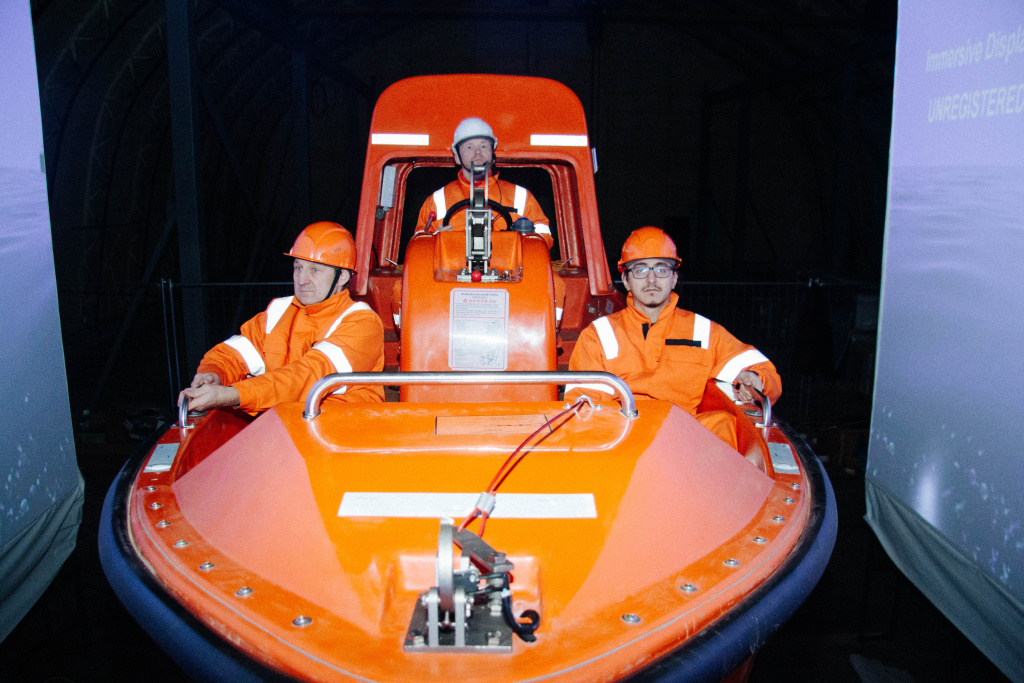
RB/FRBS-A Simulator allows:
- to drill practical skills related to the launch, recovery, operation and manoeuvring of rescue/fast rescue boats, including night drills, drills into rough seas, and drills in ice covered waters.
- implement the recommendations of model courses 1.23 and 1.24 regarding training elements aimed at equipment familiarization and rescue/fast rescue boat operation, which must be conducted on an actual lifeboat complying with the LSA Code.
RB/FRBS-A simulator belongs to class A in the classification given in the model course and based on the DNV standard - DNV-ST-0033.
Knowledge and skills
The simulator allows to drill the following skills:
- boarding Rescue/Fast rescue boat (RB/FRB),
- launching and recovering RB/FRB,
- clear the ship’s side,
- handling and manoeuvring of RB/FRB in different weather conditions, including rough seas, and at night,
- steer by compass,
- search for survival crafts and casualties on the water,
- towing survival crafts,
- approaching to the vessel
- applying search patterns,
- use communications between RB/FRB and a ship and helicopter.
Structure
The simulator includes the following equipment and software:
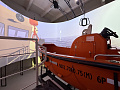
- gangway and embarkation station,
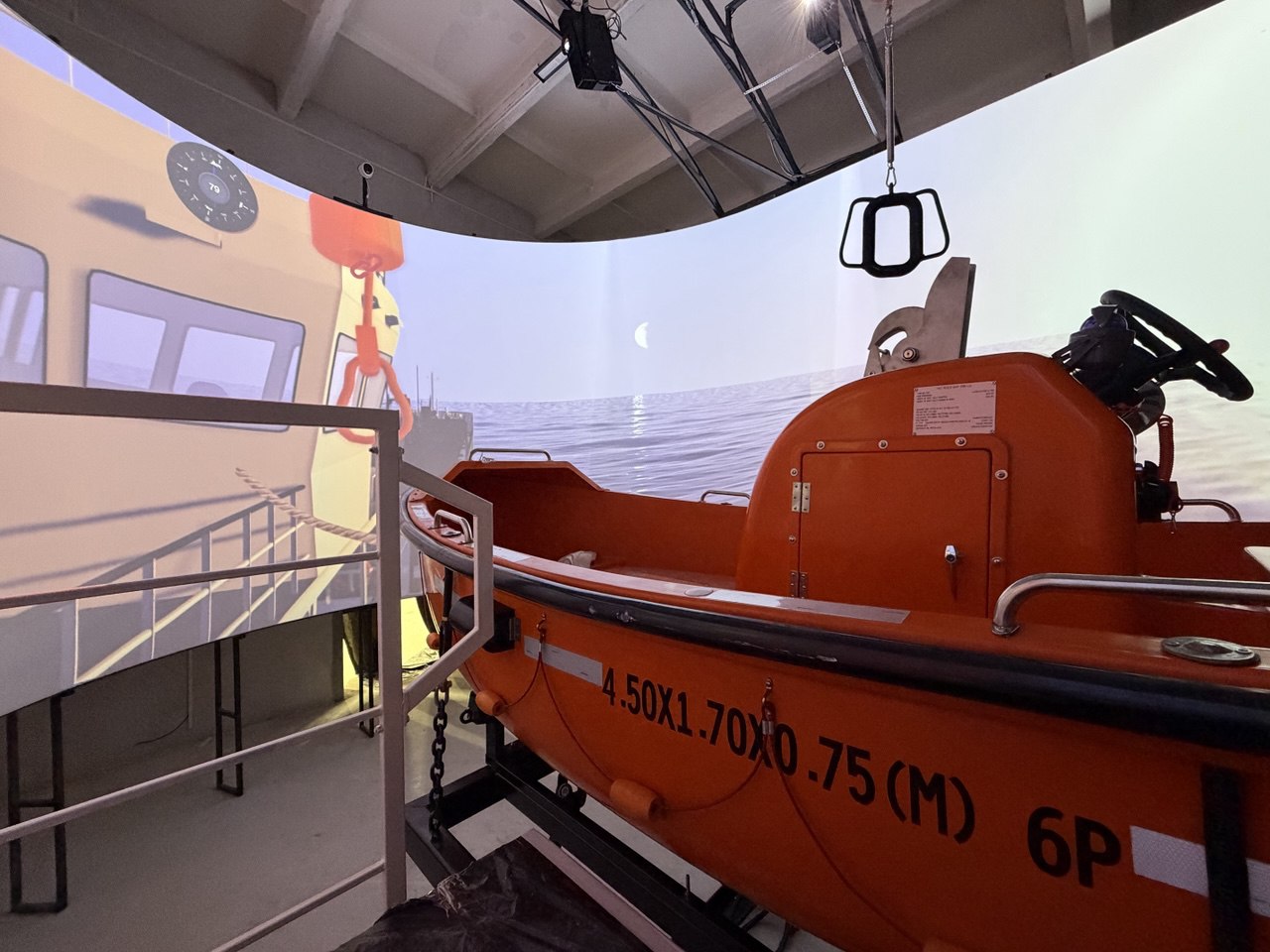
- fast rescue boat model, conforming with LSA Code, without engine,
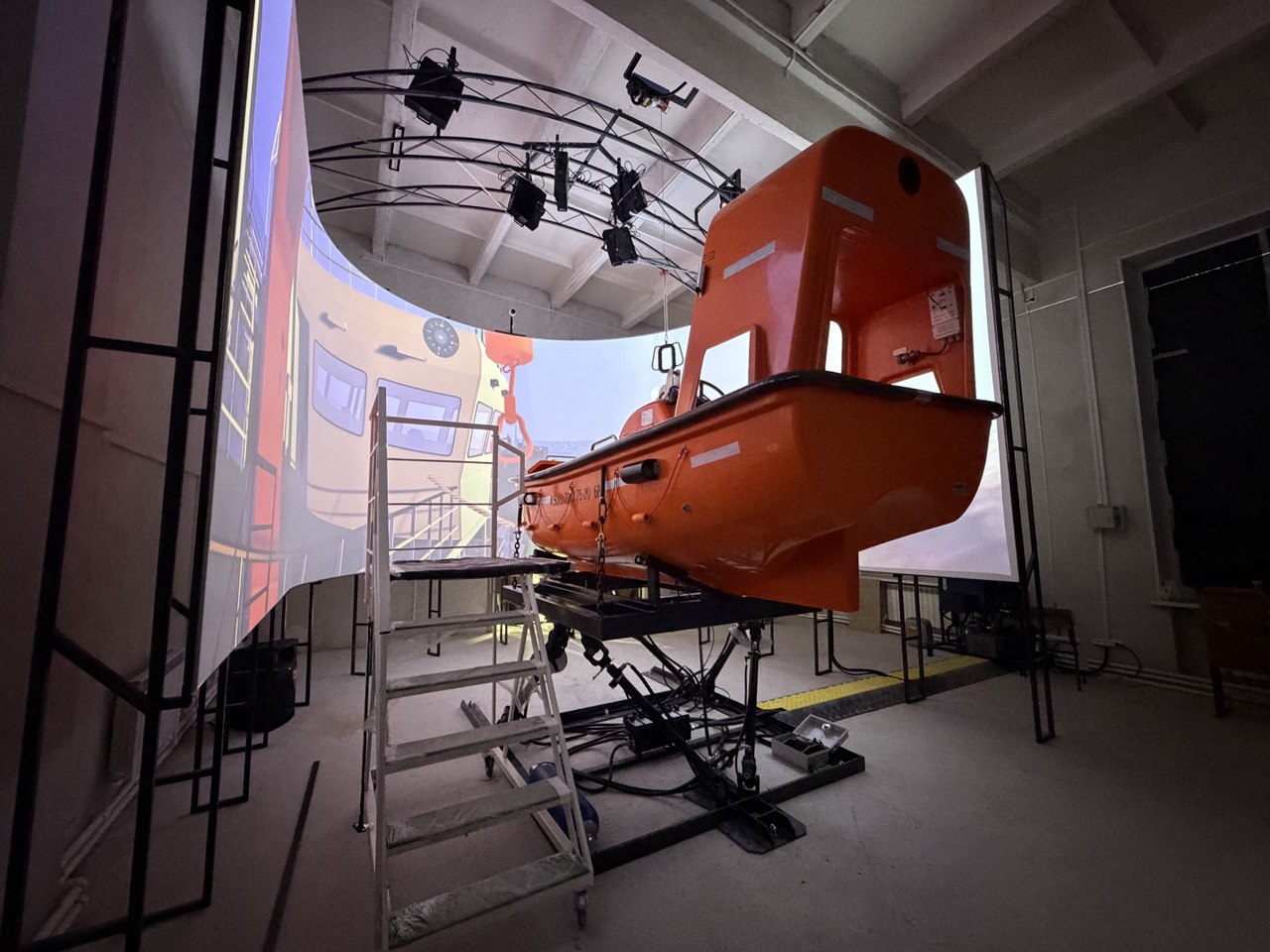
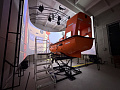
- 6 DoF dynamic platform,
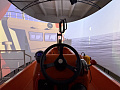
- panoramic visualization system,
- imitator of launching and recovery appliance,
- computer equipment,
- CCTV equipment,
- software.
Embarkation station
The embarkation station is designed for the embarkation and disembarkation of trainees into and out of the RB/FRB. The structure is made of metal components.
RB/FRB model
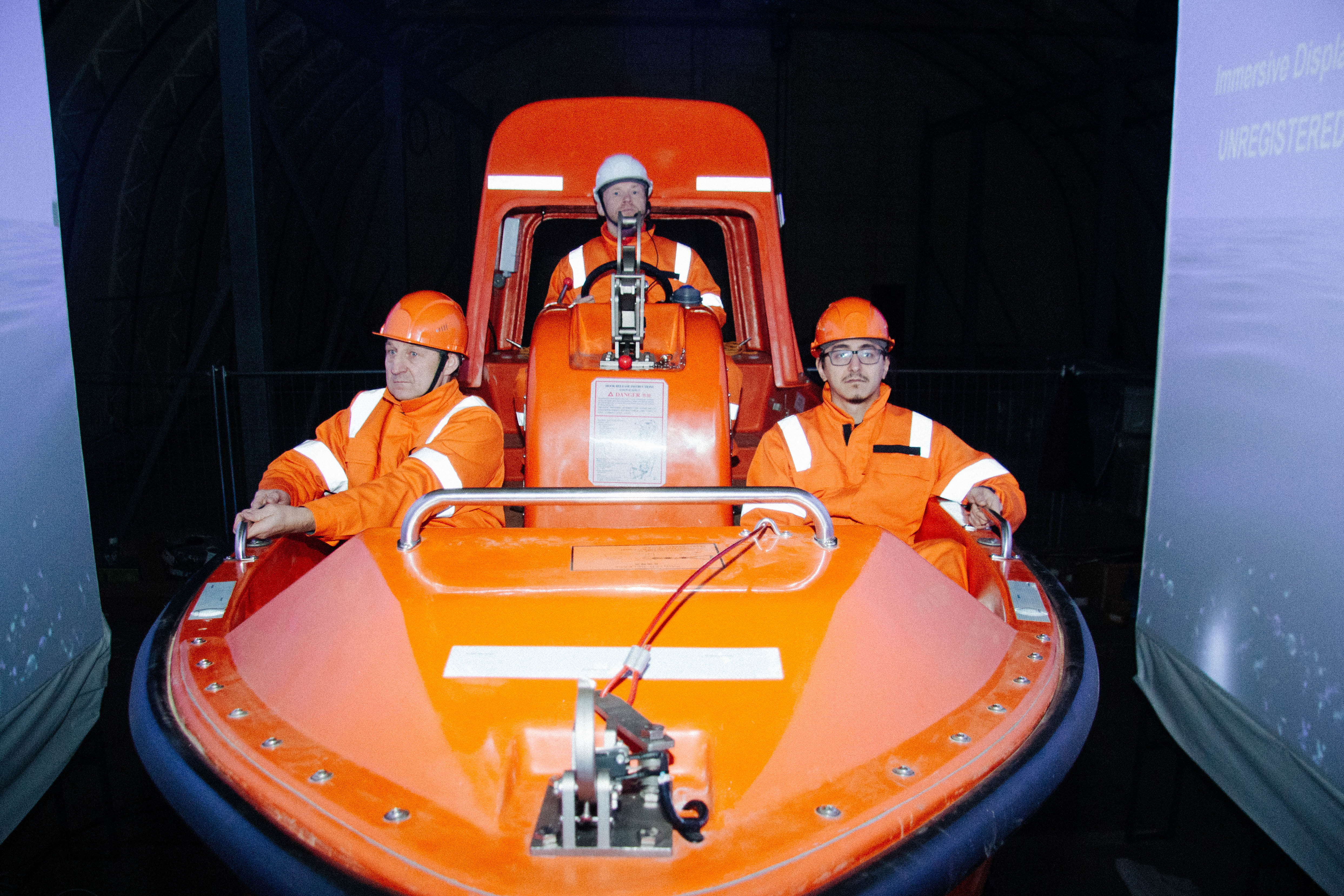
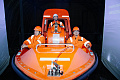
The used RB/FRB model is a real fast rescue boat, that complies with LSA Code, without engine.
The model of RB/FRB allows students to familiarize with the equipment of RB/FRB.
Main parts of the fast rescue boat model:
- The coxswain's station, equipped with safety belts,
- Remote control panel for the Launching and Recovery Appliance (LRA),
- Release lever for the releasing mechanism,
- Hook of the releasing mechanism,
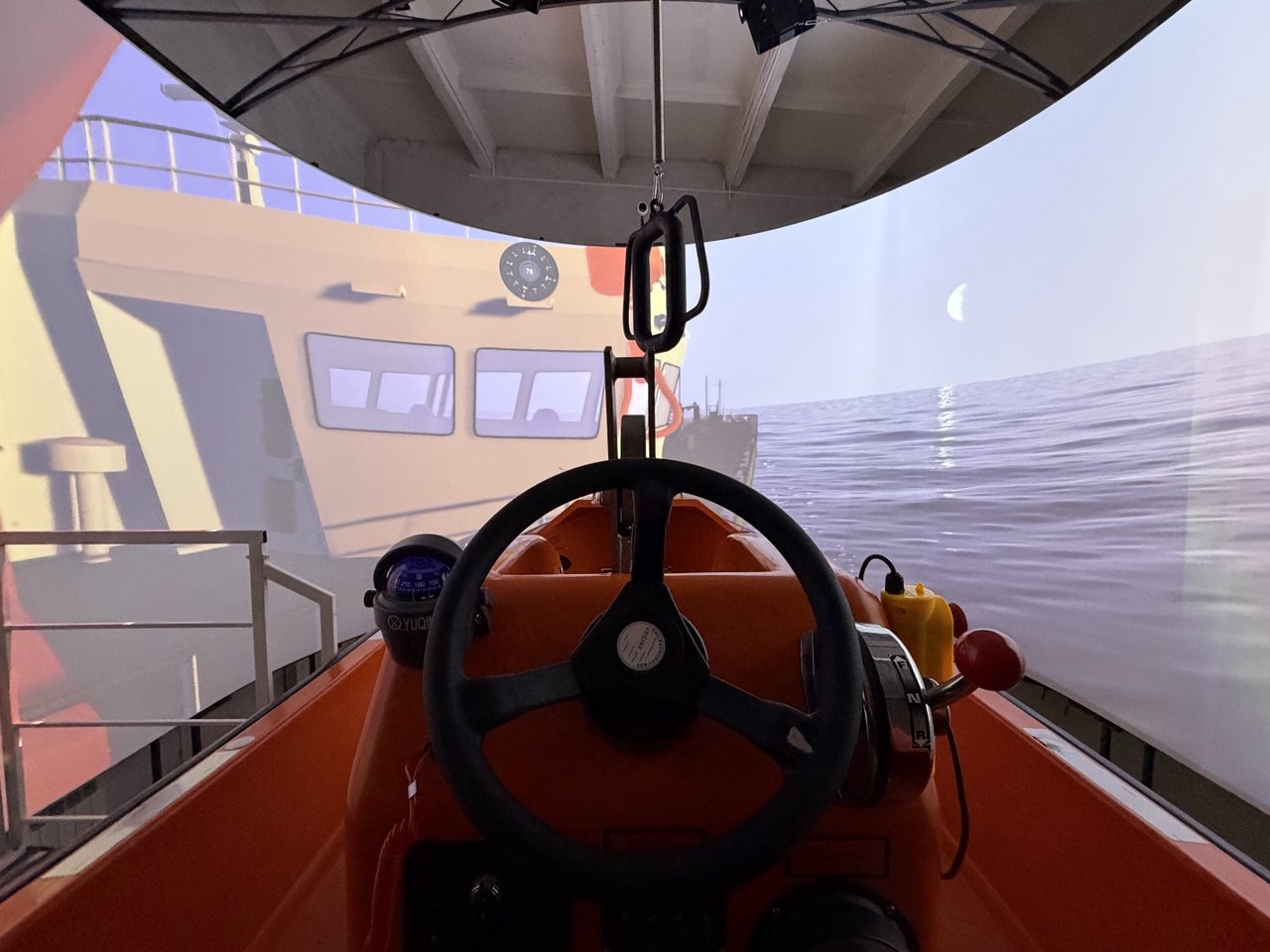
- Steering stand: engine control panel, steering wheel, engine control lever (throttle),
- Seating for the crew, equipped with safety belts.
The model is designed to be operated by a coxswain and 2 crew members.
Communication
For interaction between the instructor and the coxswain, portable VHF radios are used.
Dynamic platform
The dynamic platform is designed for mounting an RB/FRB with a crew on it and ensures the movement of the RB/FRB along the trajectories and at the speed set in the software, including launching and recovery, as well as the behavior on the water surface in rough sea.
The dynamic platform provides motion of the RB/FRB in three-dimensional space: forward/backward, up/down, left/right, as well as the ability to rotate around mutually perpendicular axes, i.e., it provides roll, pitch, and yaw of the RB/FRB.
Before launching, the dynamic platform performs movements that simulate the movement of a vessel on the waves.
The platform is a foundation-free, dismountable / assembled structure.
The platform includes the following components:
- platform base;
- upper section with an auxiliary hoisting mechanism;
- power pack (oil station).
CCTV equipment
CCTV system displays information about the progress of the training at the instructor's workplace, with the possibility of recording and archiving performance of exercises.
Simulator software
The software consists of:
- Instructor WorkPlace (IWP),
- Student WorkPlace (SWP),
- Dynamic platform control module,
- Module for processing commands from the fast rescue boat controls and launching and recovery appliance.
IWP functions:
- choice of the navigation area;
- adjusting wave height, time of day, cloudiness, drift speed and direction, precipitation;
- setting the vessel from which the is the fast rescue boat launched and target objects in the navigation area;
- VHF radio communication between the RB/FRB on behalf of the vessel, distressed vessel, rescue vessel, survival crafts, and helicopter;
- setting of virtual viewing cameras in the navigation area;
- video recording for debriefing.
- real-time demonstration of the exercise performance in real-time mode;
- dynamic platform control;
- emergency stop of the exercise, return of the simulator to its initial state.
SWP functions:
RB/FRB operation, including:
- operating an engine,
- operating a launching and recovery appliance;
- clearing the ship’s side
- handling RB/FRB in rough sea and in different weather conditions and time of the day,
- use of the main and emergency steering systems;
- use of the emergency engine stop device attached to the coxswain’s body or survival suit;
- use of the VHF radio station;
- use of the searchlight;
- use of binoculars;
- search for casualties and survival craft;
- recovery of persons from the water onboard;
- towing of survival craft to the rescue vessel;
- use of magnetic compass readings for navigation;
- approach to the vessel;
- display of the surface situation visualization system;
- physical simulation of boat behavior during launching, recovery, and in rough sea conditions.
Navigation areas:
In RB/FRB simulator is realized an open sea area with a vessel, from which an RB/FRB launches, a rescue vessel, liferafts and lifeboats, casualties, a helicopter and other target models.
Methodical guidelines for using the simulator
The simulator is supplied in the set with the guidelines for the use of the simulator, developed in accordance with the technical description and operating instructions for the fast rescue boat.
Additional options
The simulator can be supplied with e-learning modules for theoretical education, multimedia training software for practice, and knowledge assessment software for testing, which are combined into training package on the proficiency in survival crafts.
Simulator classes
The simulator can be presented in different classes:
- RB/FRBS-A – class A, full mission, on the 6 DoF dynamic platform
- RB/FRBS-B – class B, with real controls, without 6 DoF dynamic platform,
- RB/FRBS-C – class C, with pseudo-real controls, software version.
Legislation:
- Section A-VI/2 STCW Code “Mandatory minimum requirements for the issue of certificates of proficiency in survival craft, rescue boats and fast rescue boats”;
- IMO Model Course 1.23 Proficiency in Survival Craft and Rescue Boats (other than Fast Rescue Boats)” (2024 Edition),
- IMO Model Course 1.24 «Proficiency in Fast Rescue Boats»